Description
A basic task needed in some applications is to execute a motion with an imposed speed or distance, from the moment when a digital input changes its status.
The following note describes how use MotionLab2 macros programming language for using I/O conditional event (If command) to start a position motion profile moving the actuator in both directions.
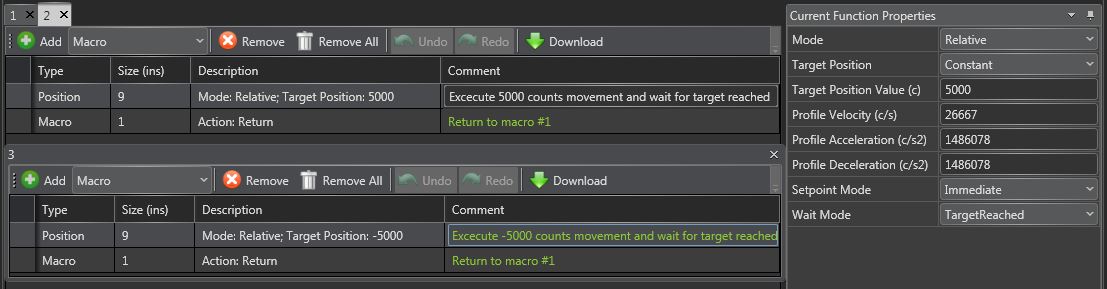
This example enables the servo motor and waits for digital input GPI1 to move the a voice coil 5.000 counts; if GPI2 is pressed, the motor moves in the opposite direction.
Application note objective:
-
Use different macros to structure the programming
-
Learn how to use program flow commands
-
Learn how to use conditional jumps based on input status
-
Learn how to perform a move
Instructions used
The notes use the following instructions
|
Instruction type |
Instruction |
Description |
Comments |
|---|---|---|---|
|
Motor control |
Motor ON |
Enables the servo drive |
Used in start-up macro 0 |
|
Program flow |
Macro jump |
Jumps to a specific macro number |
'Go To 'equivalent |
|
Program flow |
If |
Conditional jump |
It allows execution of a group of program lines if the specified expression is true |
|
Motion |
Position |
Executes an incremental or absolute move |
Use the Position command to generate a move relative or absolute to a specific number of counts |
|
Program flow |
Macro Call |
Call a specific macro |
Jumps to a macro, execute code and returns |
|
Program flow |
Macro Return |
Returns to macro call |
Returns to macro Call and executes following instructions |
Materials used
The following materials have been used for this example:
|
Products |
Version / Model |
|---|---|
|
BEI KIMCO Smart Voice coil |
LAS13-18-000A |
|
Pluto Documentation Home |
STD |
|
Pluto IO extension board |
1.0 |
|
MotionLab Configuration and programming tool |
2.7.6 |
Reference documentation
-
BEI KIMCO LAS13-18-000A datasheet
-
Pluto Servo Drive Installation Manual
Program example
At system power up, macro 0 is executed. Servo drive is Enabled and program jumps to macro #1.
-
If GPI1 is pressed, program calls Macro #3
-
If GPI2 is pressed, program calls Macro #2
-
If no input is pressed, program continues execution in macro #1
Macro #0
This macro is always executed at power-up. After the servo drive is enabled, it jumps to macro #1. This macro should contain all the initialization process.

Macro #1
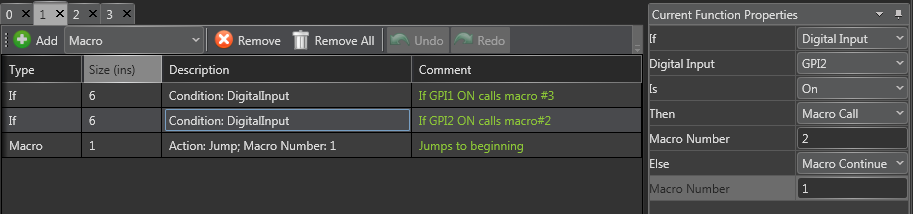
This macro checks whether GPI1 or GPI2 are pressed.
-
If GPI1 is ON it calls macro 3 otherwise remains in Macro1
-
If GPI2 is ON it calls macro 2 otherwise remains in Macro1
Macro #2 and #3
These macros execute a move function of 5.000 counts, negative or positive. Once target is reached macros return to macro call.