Introduction
In the previous step a tuning in the frequency domain was performed. In this section of the wizard the evaluation of it in time domain will be performed. It can be observed how the set bandwidth affects your system in real time (control loop+plant).
Monitoring is not supported by Everest (EVE) drives through CANopen or CoE communications. Therefore, in order to carry out Electrical Tuning please connect to the drive via Ethernet. The feature is supported on EVS.
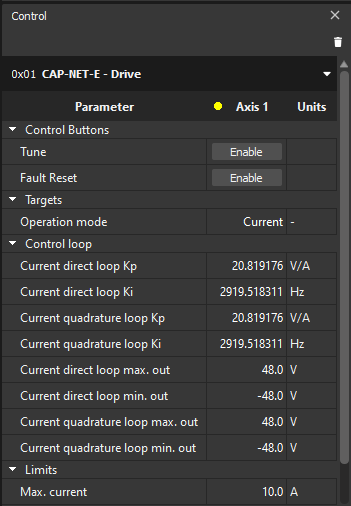
Control widget
This window has several subparts applied for this wizard section:
-
Button in charge of enabling the tuning process → Tune.
-
Button in charge of resetting a fault → Fault Reset.
-
Control loop parameters
-
Current and voltage limits.
Tuning
Using this section of the wizard, the quality of the tuning can be visually verified.
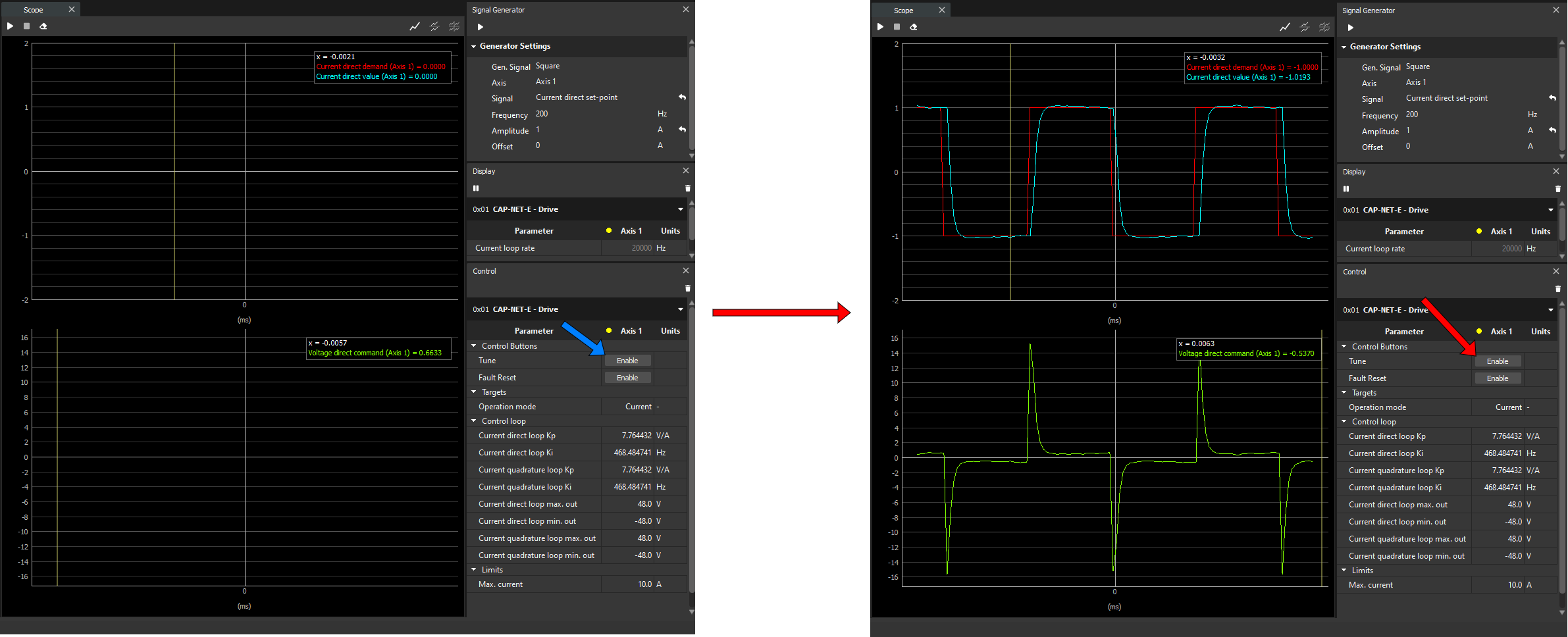
In order to tune your control loop, click on the Enable button on the right of the Tune section in the Control widget.
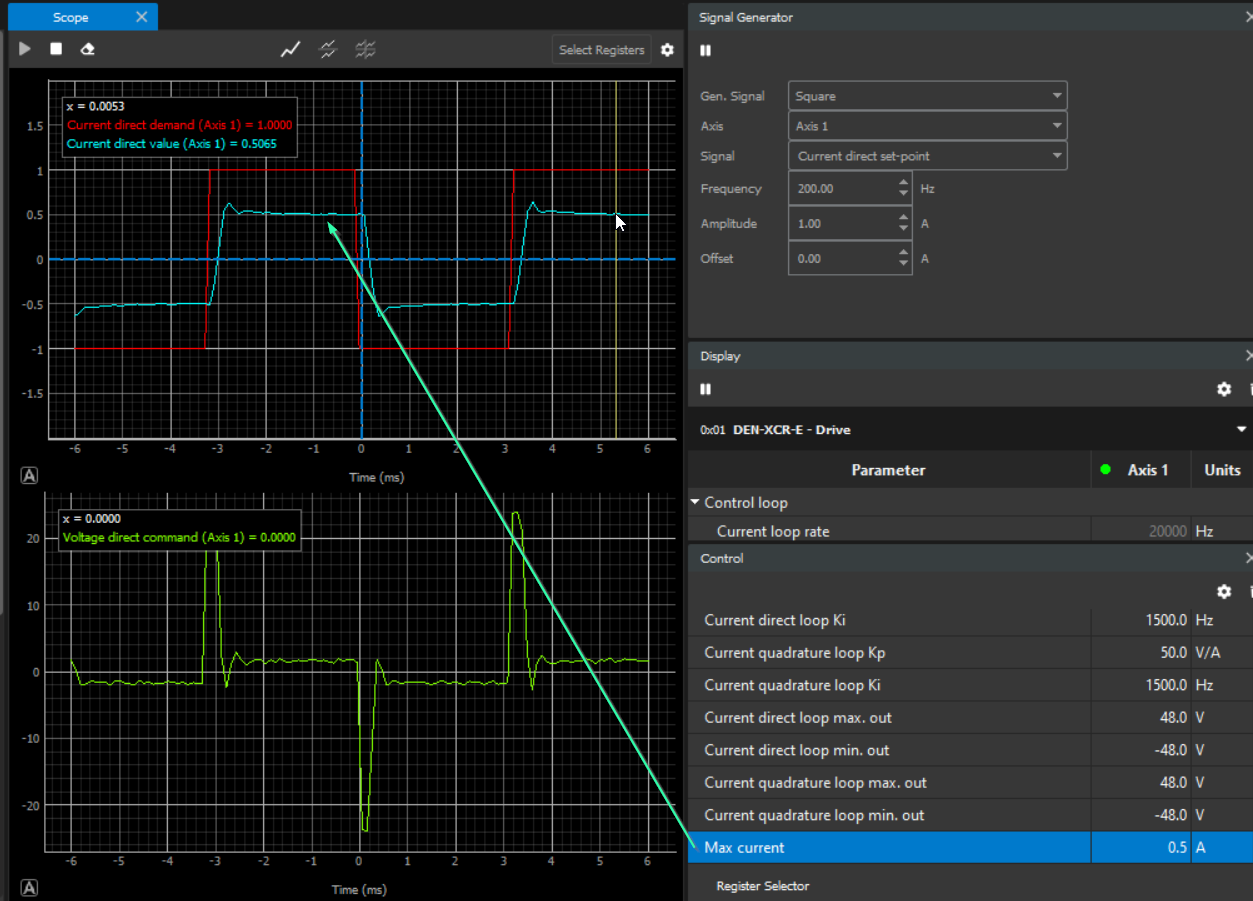
Two charts will be displayed, where:
-
The upper plot represents the current direct parameters over time: the actual value (blue) and the demand (red).
-
The lower chart shows the voltage direct command (green).
Note that the current demand signal is configured in the Signal Generator widget, located in the upper-right corner of the interface.
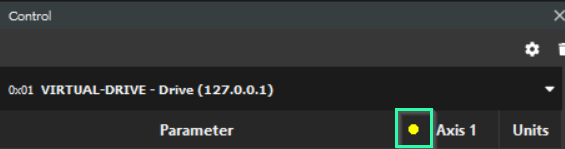
In addition, the motor status can be identified by the color of the indicator displayed to the left of the Axis 1 label at the top of the control widget:
-
Green -> the motor is enabled.
-
Yellow → the motor is disabled but active.
-
Red -> the drive is in fault state.
Control loop
Within the control section the following registers can be configured:
-
Current direct loop Kp.
-
Current direct loop Ki.
-
Current quadrature loop Kp.
-
Current quadrature loop Ki.
Only in this window is a non-salient motor configuration assumed. Therefore, the direct and quadrature current control loop parameters are forced to be identical.
Limits
You can limit the maximum current loop amplitude:
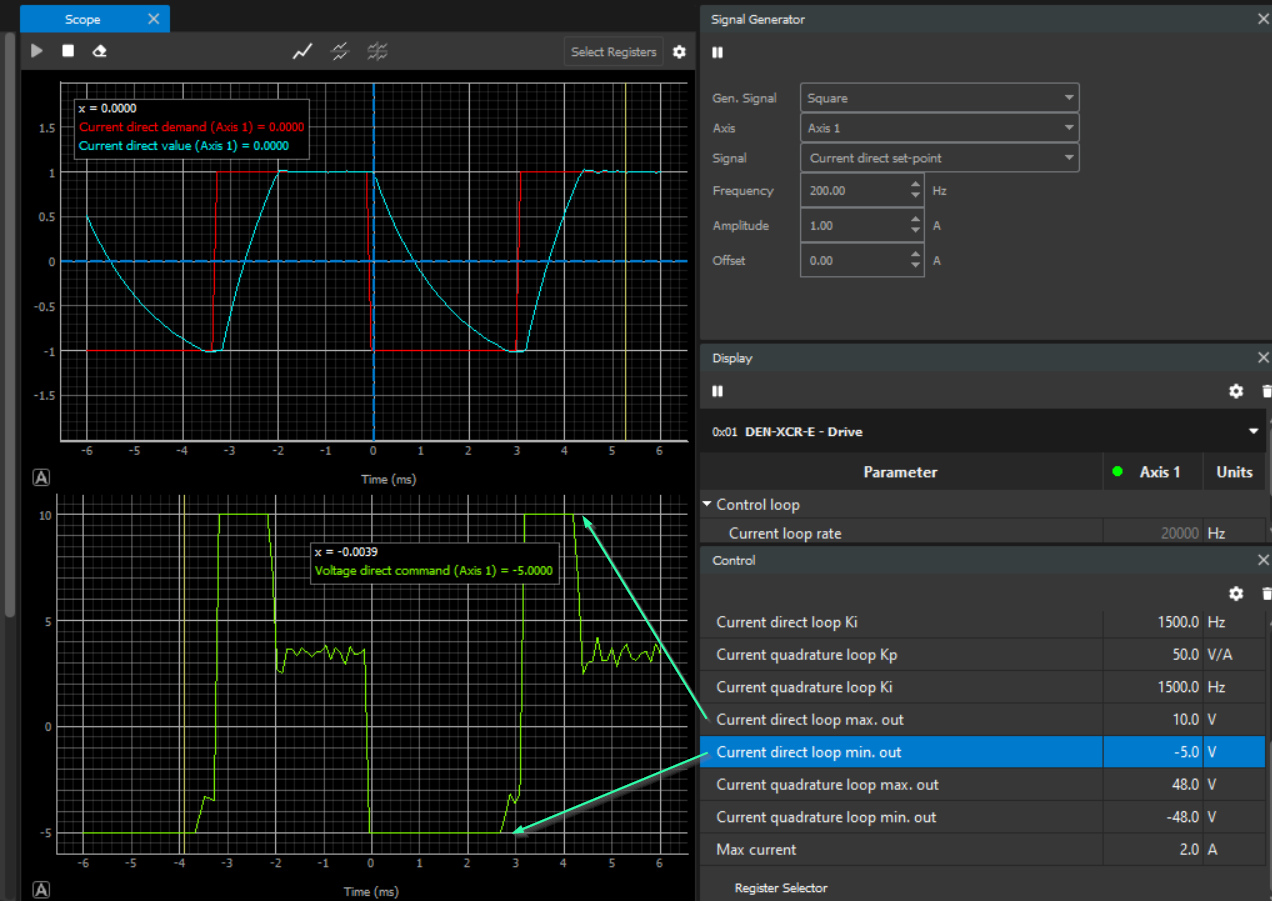
Moreover, you can specify the minimum and maximum voltage loop: