
Everest S Safe EVAL is a high power, highly integrated, ready to use digital servo drive. The drive includes all the required interface electronics and connectors and can be easily configured with Ingenia's free software MotionLab 3.
Everest S Safe EVAL is designated as an evaluation product and is strictly for evaluation purposes for the Everest S Safe NET drive. It is not approved for final application or production use.
Everest S Safe EVAL is enabled with EtherCAT communications.
Main features:
-
Ultra-small footprint
-
Up to 60 VDC, 45 A continuous
-
Up to 50 kHz current loop, 25 kHz servo loops
-
10 kHz ~ 100 kHz PWM frequency
-
16 bit ADC with VGA for current sensing
-
Supports Digital Halls, Quadrature Incremental encoder, Absolute BiSS-C encoder
-
Up to 4 simultaneous feedback sources
-
Full voltage, current and temperature protections
-
Evaluation of EVS-S-NET-E with Functional Safety: STO, SS1, SS2, SOS, SLS, SLP, SDI, SSR, SP, SV, FSoE - SIL3 and PLe being
Part Numbering
|
Product |
Ordering part number |
Status |
Image |
|---|---|---|---|
|
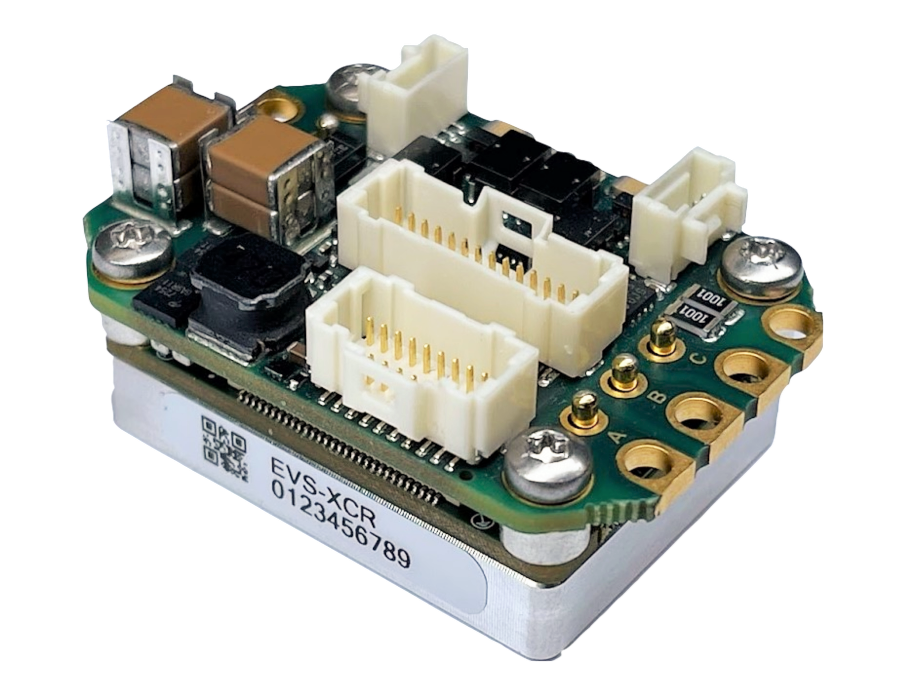
Everest S EVAL EtherCAT Ready-to-use servo drive used for evaluation of EVS-S-NET-E featuring EtherCAT communications. |
EVS-S-EVAL-E |
PRODUCTION |
|
|
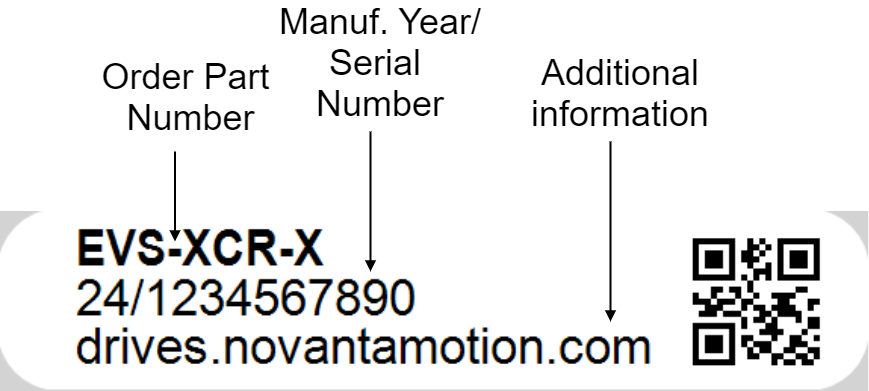
General Label Identification |
|---|
|
Specifications
Electrical and Power Specifications
|
Minimum power supply voltage |
8 VDC |
|---|---|
|
Maximum absolute power supply voltage |
60 VDC (continuous) |
|
Internal drive DC bus capacitance |
49 µF Note that EVS-S-EVAL uses ceramic capacitors. The capacitance value varies with DC bias and temperature. |
|
Logic power supply voltage (optional) |
8 to 50 VDC Providing the logic supply is optional, as the drive is supplied from the DC bus (single supply) on its full operating voltage range. When supplied from logic, an intelligent switch will stop consuming from the DC bus. |
|
Boot-up time |
4 s |
|
Minimum shutdown time |
500 ms |
|
Maximum continuous phase current |
45 A @ 60 ºC Typically, 45 A can be obtained working at 48 V, 20 kHz with an appropriate cooling to keep case temperature under 60 ºC. On higher temperatures an automatic current derating will be applied to protect the system. See Product Description#Thermal and Power Specifications below.
|
|
Maximum peak phase current |
60 A @ 1 sec Notice that peak current could be limited by an automatic current derating algorithm. In order to get 60 A, case temperature should be kept below 35 ºC. |
|
Maximum continuous output power |
> 3 kW How the output power is calculated in an Ingenia drive. |
|
Maximum DC Bus voltage utilization |
99.73% @ 10 kHz 99.55% @ 20 kHz 99.04% @ 50 kHz 95.25% @ 100 kHz Note 1: these values assume a Sinusoidal commutation and no load connected. |
Motion Control Specifications
|
Supported motor types |
Rotary brushless (SVPWM and Trapezoidal) |
|---|---|
|
Power stage PWM frequency (configurable) |
10 kHz, 20 kHz (default), 50 kHz & 100 kHz |
|
Current sensing |
3 phase, shunt-based current sensing. 16 bit ADC resolution. Accuracy is ±2% full scale. |
|
Current sense resolution (configurable) |
Current gain is configurable in 3 ranges:
|
|
Current sense ranges (configurable) |
Current ranges for the 3 configurable current gains:
|
|
Max. Current loop frequency (configurable) |
50 kHz Check the Power Stage & Control loops relationship section below. |
|
Max. servo loops frequency (position, velocity & commutation) (configurable) |
25 kHz Check the Power Stage & Control loops relationship section below. |
|
Feedbacks |
All feedback inputs are single-ended, 3.3 V logic levels. The following feedback protocols are supported and can be used outside of the Functional Safety certification:
|
|
Supported target sources |
Network communication: EtherCAT with Safety over EtherCAT (FSoE) |
|
EtherCAT |
CANopen over EtherCAT (CoE) File over EtherCAT (FoE) Ethernet over EtherCAT (EoE) Failsafe over EtherCAT (FSoE) |
|
Control modes |
|
Functional Safety Specifications
Everest S Safe EVAL is designated as an evaluation product and is strictly for evaluation purposes for the Everest S Safe NET drive. It is not approved for final application or production use.
The section below shows the Function Safety Specifications of Everest S Safe NET.
Even though Everest S Safe NET has SOUT, the Everest S Safe EVAL does not provide a connection to it.
|
Safety functions |
|
|---|---|
|
Safe Feedback |
Safe Feedback with the combination of 2 individual encoders:
See the safe feedback combinations supported below in the Safe Feedback Combinations chapter for further details. |
|
Safety Integrity Level (SIL) according to IEC 61508:2010 |
SIL3 |
|
Performance Level (PL) according to ISO 13849-1:2015 |
PLe, Cat. 3 |
|
Safety Function Reaction Time |
≤ 25 ms |
|
Safe inputs |
1 x Redundant Safe Input. Non-Isolated. Logic level (3.3 V and 5 V tolerant). Active-low. |
|
Command Source |
|
|
FSoE cycle time |
≤ 50 ms |
|
Standards compliance |
|
Safe Feedback Combinations
Everest S Safe EVAL is designated as an evaluation product and is strictly for evaluation purposes for the Everest S Safe NET drive. It is not approved for final application or production use.
The section below is relevant to the future implementation of the Everest S Safe NET drive offering Safe Motion features.
Everest S Safe NET can provide advanced Safe Motion functions by using two individual non-certified encoders (providing redundancy). It is important to take note that not all feedback combinations are supported for a safe drive (more information can be found below).
They can be integrated either in a system where there is only a motor or a motor and a gearbox attachment. When having a system with a motor + gearbox integration, the feedback sensor of the motor is referred as the redundant feedback and the one connected to the output of the gearbox as the main feedback. When the given system has only a motor, both the main and redundant feedback sensors monitor the same motor shaft.
|
Feedback Combination |
||
|---|---|---|
|
Combination code → MotionLab selection |
Main feedback sensor |
Redundant feedback sensor |
|
FBC0 → No feedback |
- |
- |
|
FBC1 → Primary absolute and secondary absolute |
BISS-C BP3 - Port 1 |
BISS-C BP3 - Port 2 |
|
FBC2 → Primary absolute and incremental encoder |
BISS-C BP3 - Port 1 |
QEI |
|
FBC3 → Secondary absolute and halls |
BISS-C BP3 - Port 2 |
Digital Halls |
|
FBC4 → Incremental encoder and halls |
QEI |
Digital Halls |
When no feedback sensors are used (FBC0), the available safety functions allowed represent STO, SOUT, SS1 (time monitoring only) and SI.
In the case of using one of the specified safety feedback combinations, the allowed safety functions are:
STO, SOUT, SS1, SI, SLS, SSR, SDI, SV, SS2, SS2, SOS, SLP, SLI, SP. For more information about this safety functions check the safety and reference manual.
Note: To guarantee enough diversity, the encoders must be of different technology or manufacturer.
Note: Other feedback combinations can be used for Motion Control purposes out of Functional Safety certification.
Even though Everest S Safe NET has SOUT, the Everest S Safe EVAL does not provide a connection to it.
Inputs/Outputs and Protections
|
General purpose Inputs and outputs |
4x non-isolated single-ended digital inputs - 5 V logic level & 3.3 V compatible. Can be configured as:
4x non-isolated single-ended digital outputs - 5 V logic level (continuous short circuit capable with 470 Ω series resistance) - 8 mA max. current. Can be configured as:
1x ±10 V, 16 bit, fully differential analog input for load cells or torque sensors. Can be read by the Master to close a torque loop. |
|---|---|
|
Shunt braking resistor output |
Configurable over any of the digital outputs (see above). Enabling this function would require an external transistor or power driver. |
|
Motor brake output |
1 A, 50 V, dedicated brake output. Open drain with re-circulation diode. Brake enable and disable timing can be configured accurately.
|
|
Safe Inputs |
1 x Redundant Safe Input. Non-Isolated. Logic level (3.3 V and 5 V tolerant). Active-low. |
|
Motor temperature input |
1x dedicated, 5 V, 12-bit, single-ended analog input for motor temperature (1.65 kΩ pull-up to 5 V included). NTC, PTC, RTD, linear voltage sensors , silicon-based sensors and thermal switches are supported. |
|
Protections |
The configurable protections are configurable up to the drive limits. In any case when the limits are reached, the drive is completely switched off with the current reduced to 0.
|
Compliance
Note: EVS-S-EVAL is an assembly of the EVS-S-NET, and a communication board. Compliance data for the EVS-S-NET can be found below.
|
EC Directives |
CE Marking
|
|---|---|
|
Electromagnetic Compatibility (EMC) Standards |
|
|
Product Safety Standard |
|
|
Environmental Test methods |
IEC 60068-2:
|
Power Stage & Control loops relationship
The power stage PWM frequency can be adjusted in 4 different frequencies. Each frequency has an associated rate for the control loops, as specified in the following table.
|
Power stage PWM frequency |
Current loop frequency |
Servo loops frequency (position, velocity & commutation) |
|---|---|---|
|
10 kHz |
10 kHz |
10 kHz |
|
20 kHz |
20 kHz |
20 kHz |
|
50 kHz |
50 kHz |
25 kHz |
|
100 kHz |
50 kHz |
25 kHz |