
Summit Series Drive Families at a Glance
The Summit Series comprises four core families designed around a common firmware architecture and modular hardware concept, optimized for different power envelopes, form factors, and integration needs.
-
EVE — Everest: High-power compact module, with extended environment options
-
EVS — Everest S: Next-gen Everest with slimmer profile, lower standby power, and extended feedback options.
-
CAP — Capitan: Mid-power, low-profile module balancing performance and size.
-
DEN — Denali: Ultra-compact, low-current module optimized for minimal size and efficiency.
Form Factors and Product Line Options
Different product variants are offered within each product family to fit different integration strategies and time-to-market needs.
-
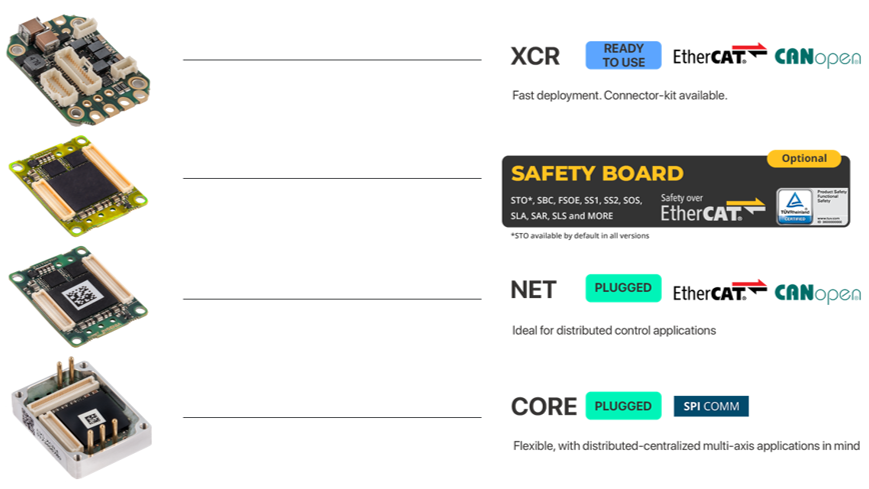
CORE (EVE-/CAP, e.g. EVE-CORE): Pluggable motion core board and power module with SPI (MCB) interface. Minimal footprint. High level of integration required
-
NET (All families, e.g. EVS-NET-E): Pluggable module with integrated industrial communications (EtherCAT or CANopen). Easier pluggable integration.
-
XCR (All families, e.g. DEN-XCR-E): Panel-mount variant with connectors, transceivers, and protection circuits for rapid bring-up and lab/field use.
-
Safety NET (EVS-S-NET, DEN-S-NET): NET-based Safe variants with Safety Core for functional safety over EtherCAT (FSoE), safe functions, and STO.
Summary Comparison
|
Family |
Form Factors |
DC Bus |
Continuous / Peak Current (1s) |
PWM Frequencies |
Standout Traits |
|---|---|---|---|---|---|
|
EVE — Everest |
Pluggable(CORE/NET), Panel Mount(XCR), Ext. Environment (EVE- E) |
Up to 80 VDC Ext. Env. up to 52 VDC |
Up to 45 A Cont./ Up to 60 A Peak |
10–100 kHz |
Extended Environment Options |
|
EVS — Everest S |
Pluggable (NET), Safe Certified (SAFE), Panel (XCR) |
Up to 80 VDC, EVS-S up to 60VDC |
Up to 45 A Cont./ Up to 60 A Peak |
10–100 kHz |
Slimmer, lighter vs EVE; lower standby power; Extended feedback compatibilities when compared with EVE |
|
CAP — Capitan |
Pluggable (CORE/NET), Panel (XCR) |
Up to ~60 VDC |
Up to 10 A Cont./ Up to 20 A Peak |
20–200 kHz |
Low-profile; rich features; excellent efficiency |
|
DEN — Denali |
Pluggable(NET), Safe Certified (SAFE), Panel (XCR) |
Up to ~48–60 VDC |
Up to 5 A Cont./ Up to 10 A Peak |
20-200 kHz |
Smallest footprint; ultra-low standby power. |
Please consult the product manuals for each drive for a full list of capabilities and specifications. Our applications team is also available to help answer any additional questions that you might have, https://ingeniamc.zendesk.com/hc/en-us/requests/new.
Differences between EVE and EVS Drive Families
The EVE drive should only be selected if the CORE form factor or extended environment option is needed. Otherwise, we highly recommend to use the EVS drive in any new applications.
|
Criteria |
EVS (Everest S) |
EVE (Everest) |
|---|---|---|
|
Form factors |
Pluggable (NET), Safe Certified (SAFE), Panel (XCR) |
Pluggable (CORE/NET), Panel Mount (XCR), Extended Environment (EVE-E) |
|
Size (NET Version) |
34.5 x 26.0 x 10.3 mm |
34.5 x 26.0 x 14.25 mm |
|
Weight (NET Version) |
18g |
23g |
|
DC bus |
Up to ~80 VDC |
Up to ~80 VDC (EVE-E up to 52 VDC) |
|
Continuous / peak current |
Up to 45 A continuous / up to 60 A peak |
Up to 45 A continuous / up to 60 A peak |
|
PWM frequencies |
10–100 kHz |
10–100 kHz |
|
Standby power (XCR) EtherCAT - 48 V - 20 kHz - Switching at 0 current |
2.33 W |
3.26 W |
|
Feedback options (NET Version) |
|
|